How to Calculate Paint for a Room, Step by Step
Learn how to measure walls, deduct doors and windows, allow for coats and coverage, and convert to gallons or liters, with fully worked room examples.
Running out of paint halfway through the last wall is frustrating, and buying three gallons too many is expensive. Calculating the right amount takes about ten minutes with a tape measure and a little arithmetic. This guide walks through the whole process, from measuring the room to rounding up to cans, with worked examples in both feet and meters.
What you need
- A tape measure (a 25 ft or 8 m one is easiest).
- A notepad or phone to record measurements.
- The coverage figure from your chosen paint, printed on the can or the product page.
Step 1: Measure the walls
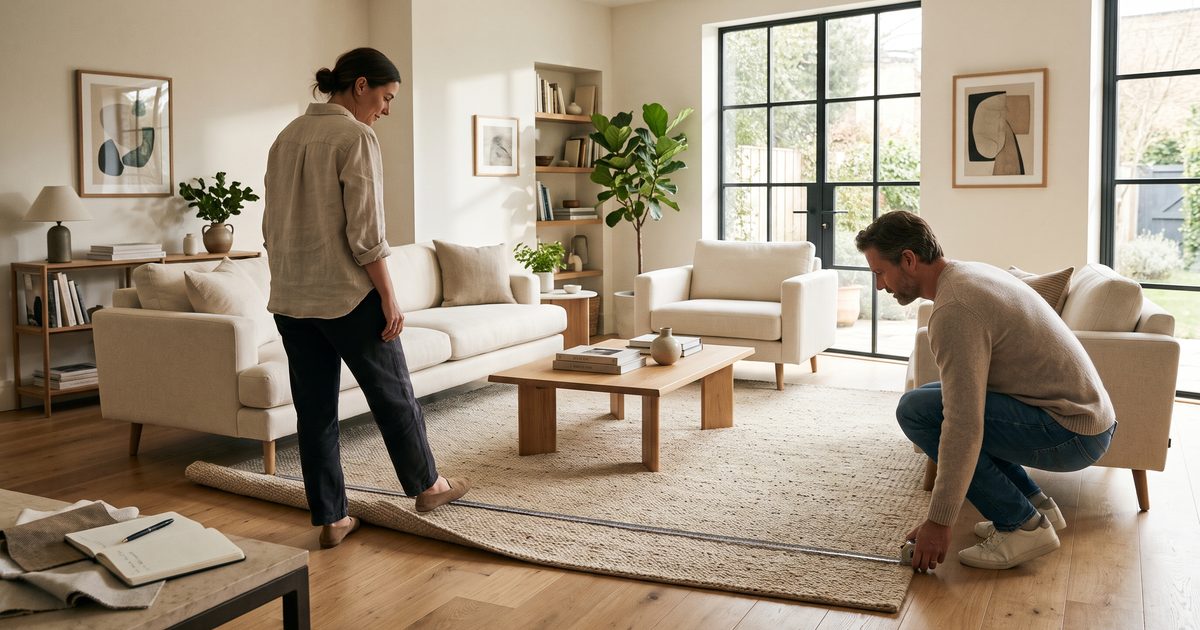
For a rectangular room, measure the length and width of the floor and the height from floor to ceiling. The total wall area is the perimeter times the height:
Wall area = 2 × (length + width) × height
For a 14 × 12 ft room with 8 ft ceilings: 2 × (14 + 12) × 8 = 2 × 26 × 8 = 416 sq ft.
If the room is not a rectangle, measure each wall's width separately, add them together, and multiply by the height. For walls with different heights, such as a sloped ceiling or a stairwell, calculate each wall on its own. A triangular gable section is half its base times its height.
Step 2: Subtract doors and windows
Large openings do not need paint. You can measure each one, or use common averages:
| Opening | Typical size | Area to subtract |
|---|---|---|
| Interior door | 3 × 7 ft | 21 sq ft (about 1.95 m²) |
| Standard window | 3 × 5 ft | 15 sq ft (about 1.39 m²) |
| Sliding patio door | 6 × 6.7 ft | about 40 sq ft (3.7 m²) |
Our example room has one door and two windows: 21 + 15 + 15 = 51 sq ft. Net wall area is 416 − 51 = 365 sq ft.
Some painters skip this step for small rooms and keep the extra as a safety margin. That is reasonable when the openings are small, but for a room with a wide patio door or many windows, the deduction can save you a full gallon.
Step 3: Decide how many coats
The number of coats depends on the surface and the color change:
- One coat: refreshing the same or a very similar color on a sound, previously painted wall.
- Two coats: the standard for most color changes and for even, durable coverage.
- Three coats or primer plus two: dramatic changes, such as covering a dark red with a pale neutral, or painting bright yellows and reds, which are often less opaque.
With two coats, the example becomes 365 × 2 = 730 sq ft of painting.
Step 4: Divide by the coverage rate
Coverage is how much area one gallon or liter paints in a single coat. Most interior wall paints list about 350 to 400 sq ft per gallon on smooth, primed surfaces. In metric, that is roughly 8.5 to 10 m² per liter. Real-world coverage is often lower on textured walls, porous surfaces and when using a thick-nap roller, so many people use the lower figure.
Gallons = total area ÷ coverage
730 ÷ 350 = 2.09 gallons. Two gallons would not be quite enough, so the practical choice is two gallons plus a quart, or three gallons if you want spare paint for touch-ups.
Step 5: Add ceilings and trim separately
Ceilings usually take a flat ceiling paint, and trim uses a semi-gloss or satin, so calculate them as separate purchases.
- Ceiling area = length × width. For the example room: 14 × 12 = 168 sq ft. Two coats at 350 sq ft per gallon is 336 ÷ 350 = 0.96 gallon, so one gallon.
- Trim: baseboards, door casings and window frames in a typical bedroom are usually covered by one quart, sometimes two for two coats on bare wood.
Worked example in metric
A living room measures 5 × 4 m with walls 2.5 m high. It has one door and one large window measuring 2 × 1.4 m.
- Wall area: 2 × (5 + 4) × 2.5 = 45 m²
- Openings: door 1.95 m² + window 2.8 m² = 4.75 m²
- Net area: 45 − 4.75 = 40.25 m²
- Two coats: 80.5 m²
- At 9 m² per liter: 80.5 ÷ 9 = 8.9 liters
Paint in metric markets is commonly sold in 1, 2.5, 5 and 10 liter cans. A 10 liter can, or a 5 liter plus a 2.5 liter plus a 1 liter, would do the job; the 10 liter can is often cheaper per liter.
Special cases
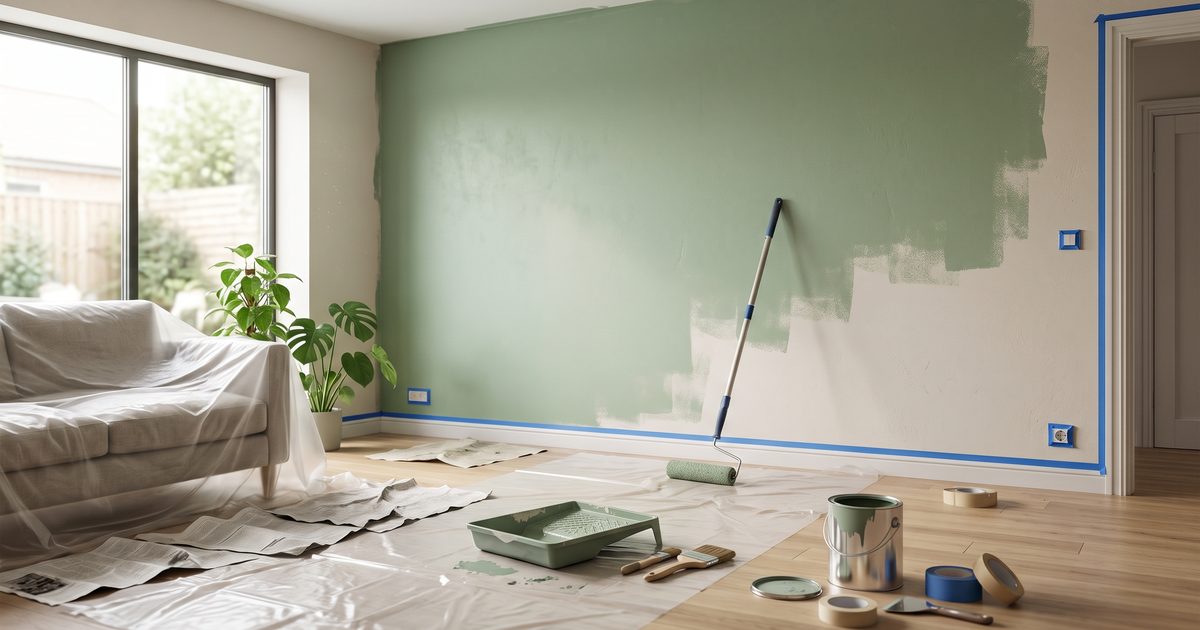
Accent walls
For one 12 ft wall with 8 ft ceilings, the area is 96 sq ft. Two coats need 192 sq ft, or about 0.55 gallon, so two quarts are often enough. Darker accent colors may need a third coat, which pushes you to a full gallon.
New drywall
Fresh drywall absorbs a lot of paint. Apply a drywall primer first, calculated with the primer's own coverage (often 200 to 300 sq ft per gallon on bare surfaces), then the topcoats.
Textured walls
Heavy texture adds surface area. Reduce the coverage figure by 20 to 30 percent, for example from 350 to about 260 sq ft per gallon.
Stairwells and tall walls
Measure the tallest point of each wall and treat sloped sections as triangles or trapezoids. A trapezoid's area is the average of its two parallel sides times the distance between them.
Buying tips
- Buy all the paint at once so it comes from the same tinting session.
- Mix cans together (called "boxing") in a larger bucket before starting if you have several gallons.
- Keep a labeled leftover with the room name, color name and date for future touch-ups.
- Check the store's return policy for unopened, untinted cans; tinted paint usually cannot be returned.
Our paint calculator performs all of these steps for you, in feet or meters, and shows the math behind the result. Still choosing colors? Try the color palette generator and read about the 60-30-10 color rule.
FAQ
How much paint do I need for a 10 × 10 room?
With 8 ft walls, the gross area is 320 sq ft. Subtracting one door and one window (36 sq ft) leaves 284 sq ft. Two coats at 350 sq ft per gallon need about 1.6 gallons, so buy two gallons.
Is one gallon of paint enough for a bedroom?
Usually not for two coats. Most bedrooms have 300 to 450 sq ft of wall, so two coats need roughly 1.7 to 2.6 gallons.
Does primer reduce the amount of paint needed?
It can. Primer seals porous surfaces and evens out color, which can sometimes reduce the topcoats needed from three to two.
How many quarts are in a gallon?
Four US quarts make one US gallon, and one gallon is about 3.785 liters.