How to Choose a Rug Size for Any Room
A practical guide to rug sizing for living rooms, dining rooms and bedrooms, with furniture placement rules, measured examples and standard sizes.
A rug does more than cover the floor. It defines a zone, anchors furniture, softens sound and ties a color scheme together. When it is the wrong size, it does the opposite: a rug that is too small makes furniture look like it is floating and makes the whole room feel smaller. The good news is that rug sizing follows a handful of simple, repeatable rules. This guide explains them room by room, with measurements you can check against your own space.
Start with the room, not the rug
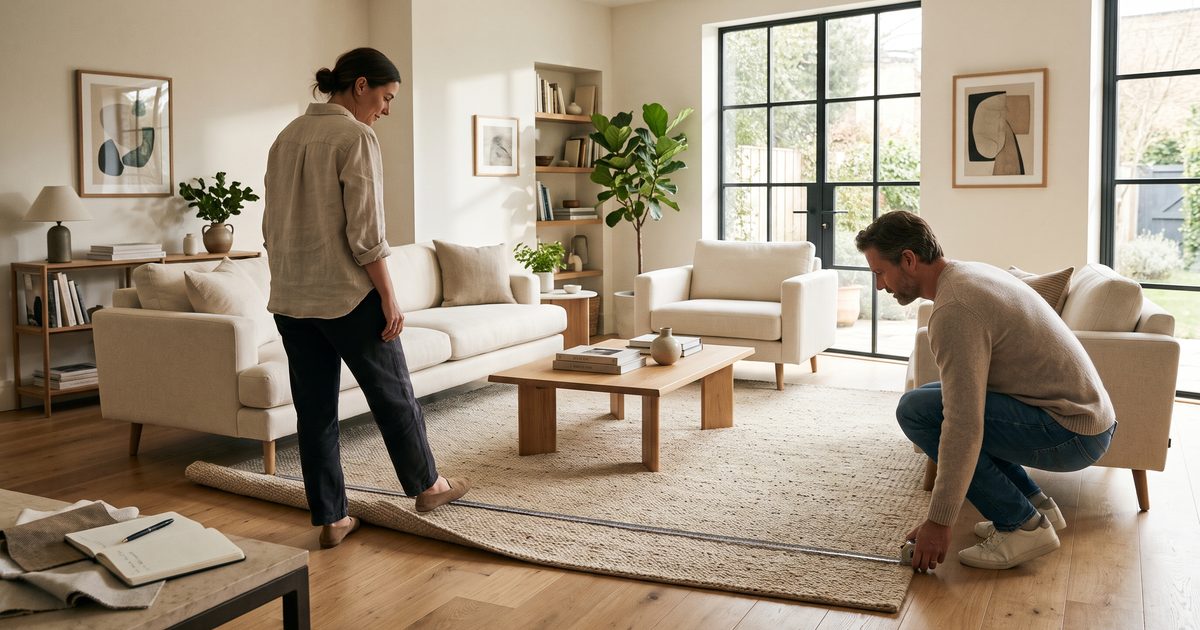
Before browsing, take three measurements:
- The room or zone. Measure wall to wall. In an open-plan space, measure only the area the rug should define, such as the seating group in a great room.
- The main furniture. Note the length of the sofa, the size of the dining table, or the size of the bed.
- Clearances. Check how far doors swing into the room and where the walkways run.
Then mark the proposed rug outline on the floor with painter's tape. It is the fastest way to see whether a size feels generous or cramped, and it costs nothing.
The floor border rule
In most rooms, an area rug looks best when a band of bare floor shows all the way around it. Designers commonly aim for 12 to 18 inches (30 to 45 cm) of floor between the rug and the walls in a typical room, and up to 24 inches in a large room. Less than about 12 inches and the rug starts to read as wall-to-wall carpet. Much more than 24 inches and it can look undersized.
Here is how that works in numbers. A living room measures 12 × 15 ft. Subtract 18 in (1.5 ft) from each side, which is 3 ft from each dimension, and the ideal rug is about 9 × 12 ft. That happens to be a standard size, which is no coincidence: rug sizes evolved to fit common room sizes.
Living room layouts
Living rooms offer three classic approaches. Pick the one that suits your furniture and budget.
1. All legs on the rug
Every piece of seating sits fully on the rug. This creates the most unified, luxurious look and works well in larger rooms or open-plan spaces where the rug defines a "room within a room." It requires the largest rug: typically 9 × 12 ft or 10 × 14 ft.
2. Front legs on the rug
The front legs of the sofa and chairs rest on the rug while the back legs stay on the floor. This is the most popular approach because it connects the furniture visually without needing a huge rug. In a 12 × 15 ft room, an 8 × 10 ft rug usually works well; in a 10 × 12 ft room, a 5 × 8 ft or 6 × 9 ft rug.
3. Coffee table only
A smaller rug sits under the coffee table with all furniture off it. It can work in a very small room or with a heavy rug you want to show off, but it often looks too small. As a minimum, the rug should be wider than the coffee table by a good margin and should reach close to the front of the sofa.
Width matters too
Whatever the layout, the rug should usually extend at least 6 inches past each end of the sofa, ideally 12 inches. An 84 in (7 ft) sofa therefore wants a rug at least 8 ft long on that side; a 96 in sofa wants 9 to 10 ft.
Dining rooms
The dining rug rule is functional rather than visual: chairs must stay on the rug when someone pulls back to stand up. If the back legs drop off the edge, the chair wobbles and catches the rug's edge every meal.
Rule: the rug should extend at least 24 inches (60 cm) beyond every edge of the table. In other words, add 4 ft to both the table length and width.
- A 6 × 3.5 ft table needs at least 10 × 7.5 ft, so an 8 × 10 ft rug.
- An 8 × 3.5 ft table needs 12 × 7.5 ft, so a 9 × 12 ft rug.
- A round 4 ft table needs an 8 ft round rug, or an 8 × 8 ft square.
Match the rug shape to the table where possible: rectangular with rectangular, round with round. Low pile or flatweave rugs are easier to clean and let chairs slide.
Bedrooms
In a bedroom, the goal is a soft landing when you step out of bed. The most common approach places a large rug sideways under the lower two-thirds of the bed, leaving the nightstands on the bare floor. The rug should show 18 to 24 inches on each side of the bed and past the foot.
| Bed (mattress size) | Rug that shows about 24 in each side |
|---|---|
| Twin (38 × 75 in) | 6 × 9 ft or 8 × 10 ft |
| Full (54 × 75 in) | 8 × 10 ft |
| Queen (60 × 80 in) | 8 × 10 ft |
| King (76 × 80 in) | 9 × 12 ft |
Check the queen math: 60 in of mattress plus 24 in on each side is 108 in, or 9 ft. An 8 × 10 ft rug turned sideways gives 10 ft across the bed, which covers it with room to spare. A popular alternative is a pair of runners, one on each side, typically 2.5 × 8 ft, which suits rooms where the bed is close to a wall.
Standard rug sizes
Most retailers stock these rectangular sizes: 2 × 3, 3 × 5, 4 × 6, 5 × 8, 6 × 9, 8 × 10, 9 × 12, 10 × 14 and 12 × 15 ft. Actual dimensions often differ by a few inches; a "5 × 8" may be 5′3″ × 7′6″. Metric rugs are usually labeled 120 × 170, 160 × 230, 200 × 300 or 240 × 340 cm. Always check the exact measurement on the listing before you compare it with your taped outline.
Common mistakes and how to avoid them
- Buying too small. If you are between two sizes, the larger one is usually the better choice.
- Ignoring door clearance. A thick rug can block a door that swings into the room. Measure the gap under the door first.
- Centering on the room instead of the furniture. In an asymmetric room, center the rug on the seating group or the bed.
- Skipping the rug pad. A pad stops slipping, protects the floor and makes a rug feel thicker. Buy it about 1 in smaller than the rug on each side.
To skip the arithmetic, enter your room and layout into our rug size calculator. For furniture arrangement ideas, see small living room layout ideas.
FAQ
What is the most common living room rug size?
8 × 10 ft is the most widely used, because it suits a front-legs-on layout in medium rooms of about 11 × 13 ft to 13 × 16 ft.
Should a rug go under the sofa?
At least the front legs should rest on it in most living rooms. That visually connects the sofa to the rest of the seating group.
Can I layer rugs?
Yes. A large, inexpensive jute or flatweave rug can provide the right size, with a smaller patterned rug layered on top for color.
How far should a rug be from the wall?
Typically 12 to 18 inches in an average room, and up to 24 inches in a large one.